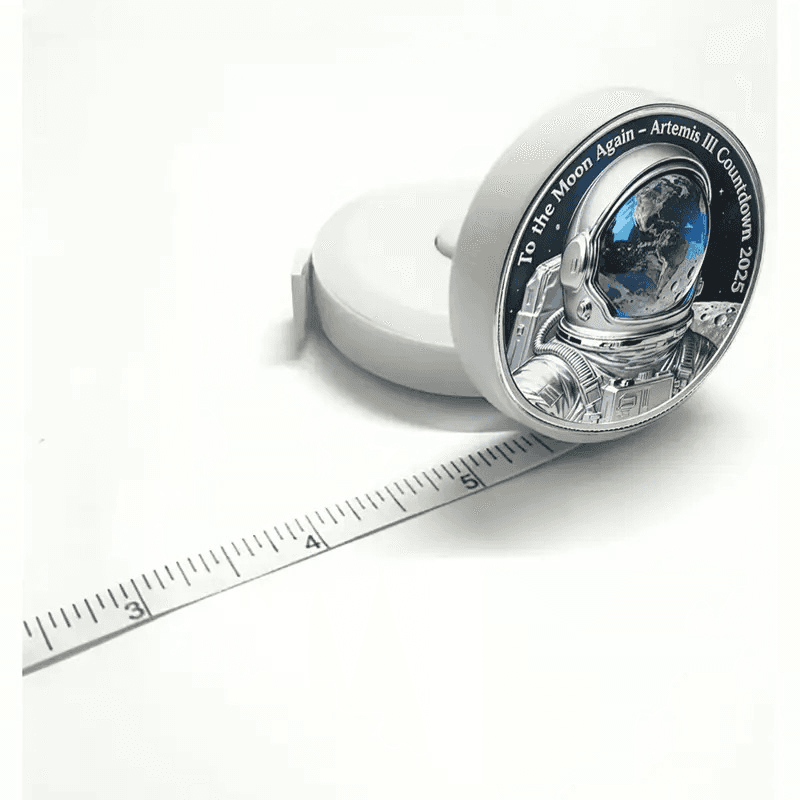
It's time to build a new set of tools to measure the modern American economy. The instruments we inherited from the last century weren't built for what's coming next, and space is one of the clearest examples. It's poised to be one of the great economic engines and job creators of the coming decades — but to get there, we need a shared understanding of what the space economy is, and what drives its growth.
Here's a strange fact: nobody actually agrees on how big the U.S. space economy is.
Ask five sources and you'll get five different numbers — some count satellite manufacturing, some fold in GPS-dependent industries like trucking, some barely count commercial space at all. There's no trusted yardstick to track whether the sector is growing, shrinking, or becoming a vulnerability.
The U.S. Office of Space Commerce (OSC) wants to fix that. This month it put out a call for research proposals to build a "government-verifiable" measurement framework — a standardized way to track the sector's size, health, and competitiveness, year after year.
The Real Problem: The Codes Are Already Outdated
Part of the difficulty traces back to NAICS codes — the government's official system for classifying industries. As space-industry commentator Michael Mealling has pointed out on LinkedIn, NAICS updates run on a strict five-year cycle, while the commercial space economy expands at roughly 7% a year. Five years is an eternity for an industry moving that fast — long enough for entire categories of jobs to exist off the books.
The deeper issue is structural: NAICS groups businesses by how they produce something, not where — with no distinction between Earth, low Earth orbit, or deep space. That forces modern space companies into imprecise, legacy buckets:
 Michael Johannessen12 min read
*The Government Bias. Old codes like NAICS 927110 ("Space Research and Technology") sit under Public Administration, assuming space work is tied to NASA — missing commercial launch providers, service providers, asteroid-mining startups, and commercial space station builders/providers entirely.
*The Manufacturing Trap. Satellite and rocket builders get lumped into NAICS 336414 ("Guided Missile and Space Vehicle Manufacturing"), hiding downstream work like space-data analytics, in-space logistics, or debris removal.
*The Ground-Based Cloud. Satellite imagery and internet companies often default to generic IT or telecom codes, erasing the fact that their workforce is space-specific at all.
Why a Miscoded Industry Is a Weaker Industry
This isn't just a paperwork quirk. Agencies use NAICS data to direct workforce-development dollars, so an undercounted sector gets underfunded. Small space companies chasing federal contracts often compete under generic engineering codes against giant, unrelated manufacturers. And schools building training programs around labor-market data struggle to design pipelines for roles the industry actually needs.
The Fix Is Already Moving — Slowly
The Bureau of Economic Analysis has noticed and is building a standalone Space Economy Satellite Account to pull space revenue out of these scattered codes. The Economic Classification Policy Committee has also reviewed structural changes for the next NAICS update, due in 2027 — a narrow window for advocates to push for dedicated codes covering spaceflight, orbital services, and space-based manufacturing.
That's the gap OSC's new study aims to close now, rather than wait on the NAICS cycle: a defensible, recurring framework built for how the space economy actually works today. The study is a small-business set-aside — OSC wants smaller research firms, not just giant consultancies, in the mix. Proposals were due September 17, 2026.
If it succeeds, the ripple effects go well beyond a government spreadsheet: whoever shapes these metrics quietly shapes how investors, journalists, and Congress understand the industry for years to come.
But space is not a one-off fix. It's a preview of a bigger problem — an economy full of industries the old measurement systems were never designed to assess. If space is going to be one of the next century's great job creators, it deserves tools built for the century it's growing in, not the one we're leaving behind. Sometimes the most consequential economic news isn't a rocket launch. It's someone deciding to build a better ruler.
Sources: https://space.commerce.gov/osc-seeks-proposals-for-u-s-space-economy-measurement-metrics-study/