Most Americans use space dozens of times a day without knowing it. Jennifer Reeves has spent more than three decades making sure they never have to notice.
That combination of operator, commander, and budget builder gives her an unusual vantage point on the questions now facing Washington: whether the country is falling behind China, whether Congress is funding the right things, and what it means that the United States has finally admitted to having weapons in orbit.
Air-minded, space-minded
Plenty of people picture air and space as one continuous spectrum: keep climbing and eventually the sky turns into orbit. Reeves disagrees. The Air Force and the Space Force share a heritage, she says, but what they do is "quite different."
The Air Force built the overwhelming majority of the nation's space capabilities. But the threat environment changed, and the domain itself became what she calls, borrowing a commercial term, "a growth industry." Space needed people focused on it alone, not distracted by other missions that are just as important.
Her analogy is the one the Air Force itself grew out of. Airmen once came from the Army, and it took a distinct service to produce people who were truly air-minded. Space now demands the same thing: people who are space-minded. "It's become that important," she says. The new service, in her view, was "timely," "relevant," and "the right thing."
Not behind, but China is closing fast
Ask Reeves whether the United States is losing the space race and she starts with a correction. "The U.S. is still ahead of everybody," she says. Count the systems on a piece of paper and America comes out on top.
What has changed is the pace of the challenger. During the Cold War, the competition was a neck-and-neck exchange with the Soviet Union while China barely registered. Over roughly the last 20 years, and especially under Xi Jinping, China has gotten "incredibly busy."
Its rate of growth in capacity and capability is, in her word, "mind-boggling." China has not caught up, but it is coming on strong, and it is trying to make a point in space.
Russia is a different problem. Reeves characterizes it as a declining space power, stretched thin by priorities that have nothing to do with orbit. That decline makes Russia more reckless, not less.
Because Russia depends on space far less than the United States does, it has less to lose from damaging the domain. She points to reports that Russia was developing a nuclear anti-satellite weapon, and to growing cooperation between Moscow and Beijing. Two adversaries, she says, "problematic, but for different reasons."
Follow the money
Reeves's most practical insight comes from her years in the “Engine Room,” so named because the Pentagon runs on money. Her advice for anyone trying to understand American strategy is to skip the strategy documents and read the budget. "Where the money lands is where the strategy is.”
The problem slowing the United States down, she argues, is one Washington chooses for itself.
Most weapons and satellite programs take years to field. Every continuing resolution and every shutdown interrupts that multi-year work. New programs cannot start. Contracts get broken, and the penalties built into those contracts come due. If a program is frozen for six months, it cannot spend a full year's money in the remaining six, so the funds must be shifted elsewhere in what she calls a zero-sum game.
The result is waste: staff time spent managing the chaos instead of managing the programs, and taxpayer dollars lost to inefficiency. Reeves notes she is a taxpayer too.
What strikes her most is how modest the fix is. "No one's asking necessarily for more money," she says. The ask is simply to pass a budget on time, so that money already agreed upon, and contracts already earned, can be executed. In her view, it is "utterly reasonable."
The space in your pocket
"Everyone uses space," Reeves says. "It is in your pocket every day." Most people never think about it, and when they do, they assume the phone is the impressive part. The phone is only one piece of a much larger system.
Her favorite example involves GPS, but not the part people know. Forget navigation. The quiet workhorse is the timing signal, a clock so precise it is measured in nanoseconds and available free to anyone on Earth with a receiver.
The global financial system runs on it. Wall Street and markets around the world stamp trades down to the millisecond and finer, and much of that timing comes from GPS. Markets are now asking how to back it up, whether through other satellite navigation systems such as Europe's Galileo or through other means, because GPS has proven it can be jammed.
That is the paradox of successful space power: it works so well that it becomes invisible, and invisibility makes it easy to forget how much depends on protecting it.
Available is not the same as assured
Commercial companies now operate much of the satellite imagery and communications the military relies on. Reeves calls that "a huge strategic advantage."

 Lynn Schmidt6 min read
Private industry moves faster, iterates more, and brings industrial capacity the government could never build alone. But she draws a sharp line: "Commercial availability is not the same thing as assured military capability."
The risk runs in two directions. First, commercial satellites become targets. Russia attacked the satellite operator Viasat at the very start of its invasion of Ukraine, and Reeves asks what a private company is supposed to do to defend itself in orbit. If a commercial satellite supports a military operation, is it a lawful target? Those questions have been asked, she says, but not yet thoroughly answered.
Second, a company's business interests may not match the military's needs. A board or an owner can decide to switch a service off, and suddenly a capability built into a war plan no longer exists. "Now what?" Reeves asks.
Both the government and industry need to work that problem from their own side, and she is encouraged that current events are finally forcing the conversation.
Weapons in orbit
On September 14, Air Force Secretary Troy Meink told the Air & Space Forces Association's Air, Space and Cyber Conference that the United States now has on-orbit space control weapons capable of defending the joint force. It was the first such public acknowledgment, and Gen. Douglas Schiess, the new Chief of Space Operations, confirmed it the next day.
After 29 years as a space officer, Reeves admits she was "tickled" to hear it said out loud. Her reasoning is classic deterrence: "You can't have a deterrent if no one knows about it." China has been unusually aggressive in space, and an adversary has to know the United States can respond before it will think twice about acting.
Space Superiority
The goal is space superiority, the ability to use space at the time and place of America's choosing while, if necessary, denying adversaries the same. The best outcome is a deterrent strong enough to keep the country out of conflict altogether.
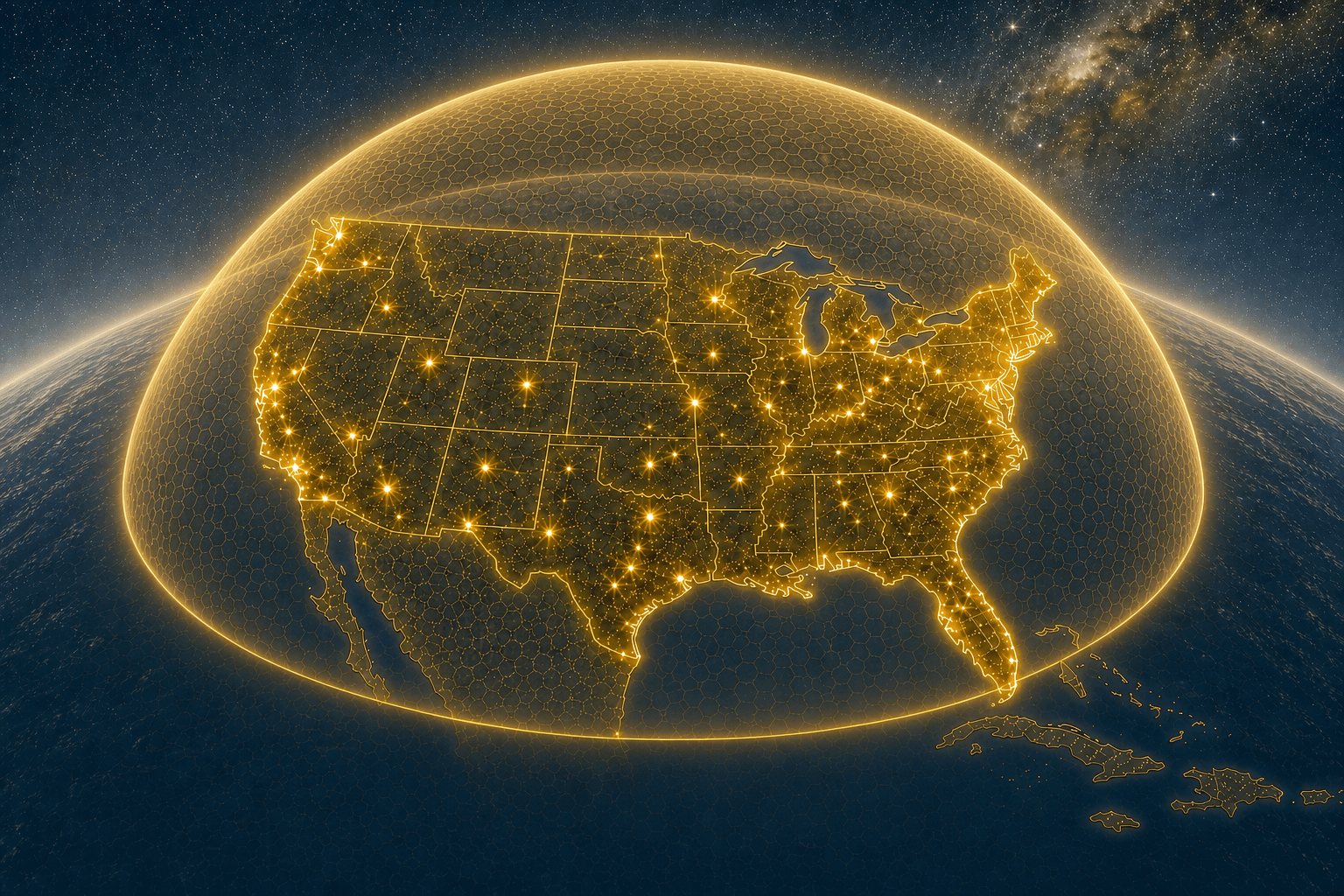
Golden Dome
On President Trump's Golden Dome missile defense initiative, Reeves sees continuity more than novelty. Homeland missile defense is an enduring priority that predates this administration, even if attention to it faded after the Cold War. As she understands it, Golden Dome blends capabilities the country has fielded for years with new technologies still to be developed.
Her prediction for the program after Trump leaves office is pragmatic: the mission endures, funding pressures will shape what gets built, and a future administration may simply call it something else.
The network is a weapon system
Reeves's recent paper for the Mitchell Institute starts from a simple observation: satellites are now generating more data than anyone can wrap their heads around, and the networks meant to carry it have not kept up. Space, she argues, is out ahead of the network.
She lays out three lines of effort to close the gap.
Laser communications. Optical links offer orders of magnitude more bandwidth than the radio frequencies the military relies on today. A laser beam is also far more tightly focused, leaving adversaries much less opportunity to jam or intercept it. Starlink already uses lasers between satellites; the harder problem is beaming data down to the ground, where clouds block the signal much as they would a laser pointer.
Smarter satellites. Instead of sending every high-resolution image to Earth, satellites can use onboard AI to send only what a user needs. Her paper cites the following example: rather than transmitting full photographs of a forest fire, a satellite can send down where the fire is, how big it is, and what surrounds it, faster and with far less bandwidth.
Better use of radio frequency. Nearly everything coming from space still travels on radio frequencies, so new encoding and encryption methods can squeeze more out of the systems already in place.
The technical details matter less to her than the strategic point, and it is the one message she wants every member of Congress to remember: “The network is a weapon system and not just an enabler. Fund it like such. Otherwise we’ll be left behind.”
Winning the Future
Asked for one idea that would help America win the future, Reeves offers something closer to a disposition than a program. The country needs to lean into things that make it uncomfortable, including things it may not fully understand. Her example is space superiority itself: technically daunting, hard to explain, and easy to tune out.
She hopes Americans will extend some trust to the people doing that work for a living, and doing it for the right reasons. Space is now part of the fabric of daily life. If those capabilities were taken away, she warns, the country would be back at the beginning, forced to start fresh.
That warning is the thread running through everything Reeves says. Space power succeeds when no one notices it. The danger is that a nation that never notices it may also forget to pay for it, plan for it, and defend it.